New rules are set to restrict Cash ISA savings in the UK. But did you know there’s a range of ETFs that can perform a similar role in your Stocks and Shares ISA?
The annual allowance for Cash ISA savings drops from £ 20,000 to £ 12,000 from April 6 2027. You’ll still be allowed to put the full £ 20,000 in your Stocks and Shares ISA every year but new penalties will be imposed if you park cash there.
Thankfully however, there’s a class of ETFs that deals with these problems. Using these ETFs you can:
Invest up to £ 20,000 per year in an ISA-eligible, cash-like asset.
Not fall foul of the new 22 % flat tax imposed on cash in Stocks and Shares ISAs.
Preserve capital by holding low volatility ETFs that typically pay interest in the same bracket as a competitive easy access savings account.
Cash cowed
Let’s take a step back for a moment to recap why this is worth thinking about. From 6 April 2027, the Government is introducing new rules to prevent under-65s from saving more than £ 12,000 per year into their Cash ISA.
They’re also taking steps to discourage cash holdings in non Cash ISAs too.
These so-called anti-circumvention rules are relatively straightforward:
Interest paid on cash held in a non Cash ISA is subject to a 22 % flat-rate charge.
Under 65s cannot transfer money from a non Cash ISA to a Cash ISA account.
A money market fund (MMF) may not occupy 100 % of a Stocks and Shares ISA account.
Can you hold one share in a non money market fund and comply with the rules? HMRC - the UK’s tax authority - has not yet published the final version of the rules so we cannot say for sure what the sub-100 % threshold will be just yet.
However, HMRC have said that only money market funds will be classified as “cash-like assets”.
Therefore other low-risk ultra-short and short maturity ETFs will not have any restrictions imposed upon them, while the guidance issued so far shows that the new rules are intended to strike a delicate balance:
Prevent people using Stocks and Shares ISAs as simple cash accounts as per government policy.
But still allow investors to carry on using MMFs in their ISAs to manage key investment objectives such as derisking, capital preservation, and holding dry powder while waiting for a buying opportunity in stocks.
How do cash-like assets behave?
Money market funds (including the ETF versions) aren’t cash but are designed to be similarly stable so that investors can manage risk and liquidity.
As such, MMFs act as a low volatility store of wealth that pays interest.
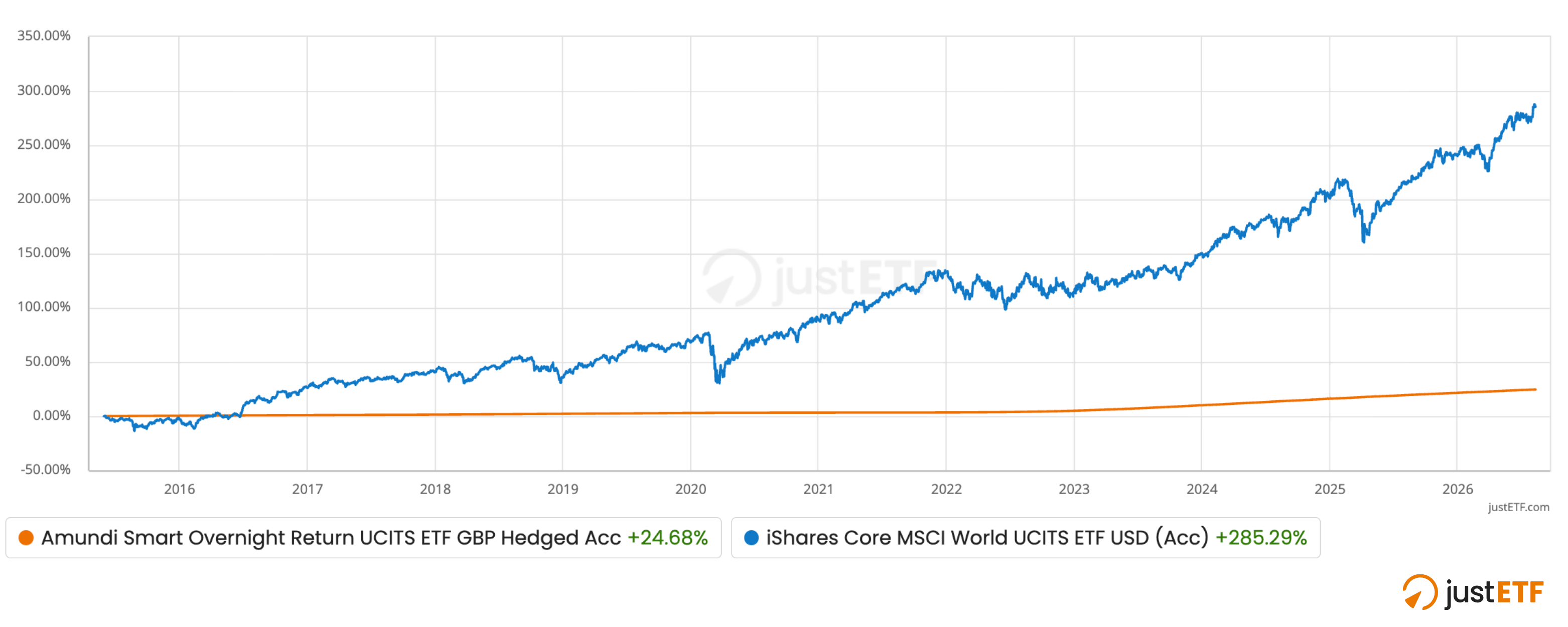
The next chart demonstrates how this looks in practice by comparing the trend line of a World equities ETF (SWDA) with a popular money market ETF (CSH2):
Source: justETF research, 12.08.2026. Nominal total returns in GBP since the launch of CSH2. ETF fees included.
As you’d expect, the blue equities return line is hard-charging but choppy. Meanwhile, the orange money market line is as calm as a duck pond.
It doesn’t grow fast but your holding doesn’t abruptly plunge in value either. Essentially, you can put money into an MMF and expect to withdraw much the same amount a while later. It doesn’t yo-yo all over the place.
That stability story is borne out by the ETF’s risk comparison metrics too:
justETF Tip: To compare ETFs, tap the Compare button on your selected ETFs’ profiles. Then hit the Compare selection in detail option in the orange bubble top-right. Now you can view each ETF’s key metrics side-by-side.
The volatility numbers reveal that the money market ETF (left-hand column) is very stable. That is, its minimal volatility score indicates that the ETF’s returns cluster right around their average over the periods shown.
By contrast, the greater volatility figures of the equities ETF confirm that its returns often swing far from the mean - whether that’s higher or lower.
In other words, the World equities ETF is a risky investment - it’s quite capable of dishing out pain alongside its gain, as you would expect.
While on the other hand, the money market ETF has the profile of a low risk, low return asset - much like cash.
The contrasting nature of the two ETFs is obviously reflected in their maximum drawdown scores too.
What should I look for in an MMF?
In a nutshell, a GBP money market ETF will track the SONIA (Sterling Overnight Index Average index) index. This is the UK’s main interbank lending benchmark.
In practice, SONIA is closely tied to the Bank of England’s Bank Rate, so the ETF’s interest payments should pay a similar amount to a decent easy access savings account.
But the advantage with a money market ETF is you don’t need to keep switching accounts to stay on top of interest rate changes.
The index does that for you.
Search Money Market in our ETF Screener and find out more in our dedicated money market ETF article.
Spice up your life
If you want to add a little more return in exchange for a touch more risk then check out:
Ultra-short maturity GBP ETFs such as ERNS and QUID.
Short maturity (0-5yrs) UK government bonds (also known as gilts)
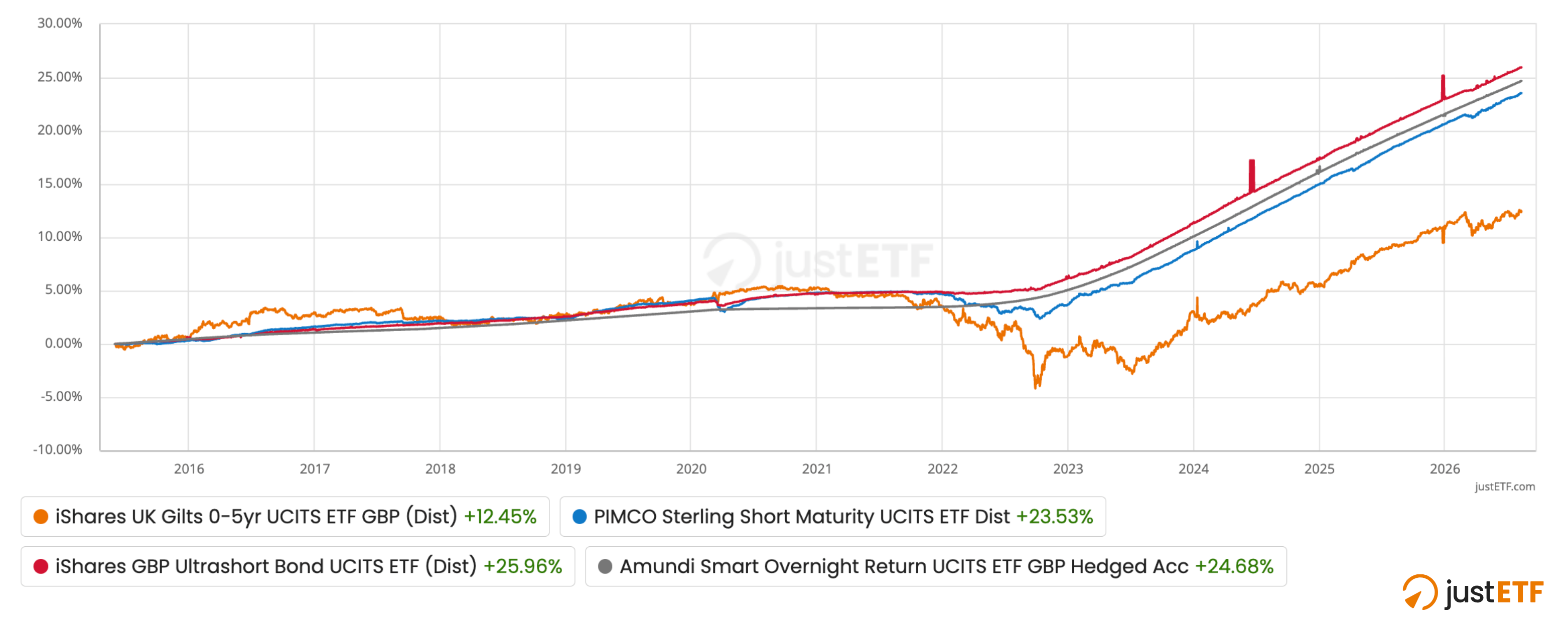
The next chart shows where these ETFs sit on the risk-reward spectrum versus MMFs:
The grey return line is our cash-like money market ETF. This is our baseline expectation.
Against that, you can see that ERNS (red line) has earned a smidge more over the period in exchange for a bit more volatility - see the spikes and wider undulations in the trend line.
QUID’s blue line is also slightly more ragged than the MMF and it’s a little off the pace, too.
Finally, the short maturity gilt ETF (IGLS) took a big hit (comparatively) in 2022-2023 and is clearly riskier than the rest.
Again, the risk section of the ETF comparison table is highly revealing:
Compare ERNS’ 5 year volatility score with IGLS (green). The two are roughly as volatile but IGLS’ maximum 5 year drawdown is much higher.
Why the difference?
In brief, ERNS’ ultra-short term debt holdings were scarcely dented by the 2022 interest rate hikes.
The debt matured quickly (often in weeks or months) so the ETF’s capital could be swiftly redeployed into new securities paying higher rates of interest.
By contrast, most of IGLS’ gilt portfolio hangs around for a few years. So when rates rise you’re stuck with less competitive interest-bearing assets that take time to mature.
The market response is to discount the older, low-paying bonds so that their return to maturity is level with new higher interest rate debt.
Think of it like iPhone prices. When a new iPhone is released then older models must be reduced to clear.
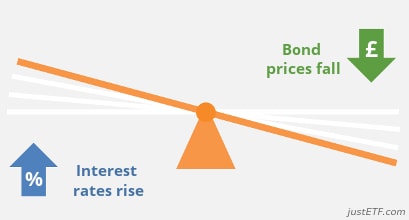
Similarly a bond ETF’s price falls when interest rates rise - reflecting the revaluation of its older bonds as fresh, higher-paying debt hits the market.
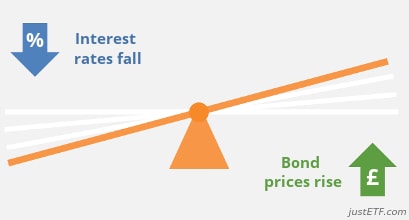
The process plays out in reverse when interest rates drop. In that scenario, longer-term bonds are better than shorter ones.
Why? Because longer bonds pay out at the old, higher rates for years after the fall.
Short-term debt, on the other hand, matures more quickly, and the capital is then reinvested into new securities that pay income at the lower rate of interest.
Thus bond ETFs full of longer-term securities typically rise higher than shorter-dated equivalents in a falling interest rate environment.
When market interest rates rise, bond prices fall. When interest rates fall, prices rise.
That dynamic explains why IGLS was tracking ahead of its ultra-short rivals up until 2021. Interest rates were mostly trending down during that period, so longer term bond ETFs were outperforming shorter term products.
The upshot is there’s nothing wrong with IGLS. It’s just longer term than the others, and so more sensitive to interest rate changes for better or worse.
Finally, QUID and CSH2 (magenta annotations) are comparable products except that CSH2 is less volatile and has registered a lower maximum drawdown over the time period.
If you’re looking for a cash proxy then CSH2 is doing a better job on this read.
Cash-like but not cash
There are clear differences between MMFs and cash that it’s important to be aware of.
Firstly, the FSCS compensation scheme protects your bank account up to £ 120,000, but only backstops your brokerage account up to £ 85,000. (You need to confirm your broker is covered by the scheme, too.)
Secondly, while money market funds often hold some cash deposits, their portfolio is typically diversified beyond that.
Thus physical MMFs generally hold large percentages of ultra short-term corporate and government debt.
While synthetic money market ETFs use a swap contract to pay out the index return, and invest their shareholders' contributions into a broader range of assets that act as collateral.
The collateral is maintained to pay back investors should the swap provider ever fail to meet the terms of the contract - a possibility known as counterparty risk.
Ultimately, it’s fair to say that MMFs are better diversified than a single bank yet are a more complex arrangement than any savings account.
Reassuringly, the UK and EU subject MMFs to very tight regulation because they play a systematically important role in the financial system as a source of short-term funding for banks, governments, and large corporations.
Easy money
That completes our tour of cash-like ETFs plus the ultra-short maturity investments that live nearby on the risk-reward spectrum.
If you’re searching for a low-risk product to fill out your ISA allowance then hopefully you’ll find something here that fits the bill.
Stay up to date
Free English newsletter including the latest news & knowledge about investing in ETFs.


 The grey return line is our cash-like money market ETF. This is our baseline expectation.
Against that, you can see that ERNS (red line) has earned a smidge more over the period in exchange for a bit more volatility - see the spikes and wider undulations in the trend line.
QUID’s blue line is also slightly more ragged than the MMF and it’s a little off the pace, too.
Finally, the short maturity gilt ETF (IGLS) took a big hit (comparatively) in 2022-2023 and is clearly riskier than the rest.
Again, the risk section of the ETF comparison table is highly revealing:
The grey return line is our cash-like money market ETF. This is our baseline expectation.
Against that, you can see that ERNS (red line) has earned a smidge more over the period in exchange for a bit more volatility - see the spikes and wider undulations in the trend line.
QUID’s blue line is also slightly more ragged than the MMF and it’s a little off the pace, too.
Finally, the short maturity gilt ETF (IGLS) took a big hit (comparatively) in 2022-2023 and is clearly riskier than the rest.
Again, the risk section of the ETF comparison table is highly revealing: