Comment les ETF répliquent-ils leur indice ? Retrouvez ici les principales méthodes de réplication des ETF
L’objectif d’un ETF est de répliquer son indice de référence de la manière la plus précise et la plus économique possible. Les revenus générés par les titres de l’indice, comme les dividendes ou les intérêts, sont également pris en compte dans le fonds. Vous pouvez ainsi profiter de l’évolution de l’indice, mais aussi des revenus générés par ses composants, selon la politique de distribution de l’ETF.
Plusieurs méthodes se sont développées pour répliquer les indices. Voici les principales.
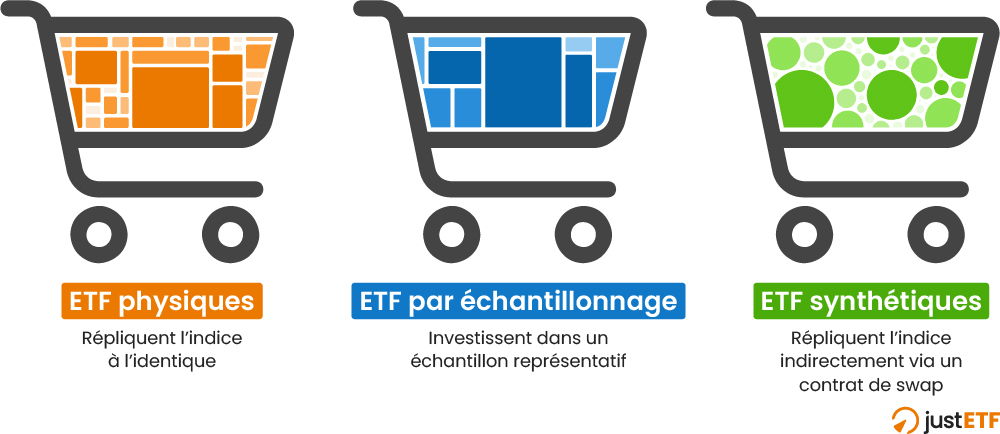
La méthode classique est la réplication physique. Dans ce cas, l’ETF achète directement les titres qui composent l’indice. Lorsque l’ETF détient tous les titres de l’indice dans les mêmes proportions, on parle de réplication physique complète.
Cette dernière n’est toutefois pas toujours possible ou pertinente. Certains indices sont très larges, internationaux ou composés de titres peu liquides. Acheter tous les titres de l’indice peut alors devenir plus complexe ou plus coûteux.
Dans ce cas, l’ETF peut utiliser une réplication physique par échantillonnage. Il ne détient pas tous les titres de l’indice, mais une sélection représentative de ses composants. Cette sélection est généralement déterminée à l’aide de modèles et d’outils informatiques qui cherchent à reproduire au mieux les caractéristiques de l’indice. L’objectif reste de suivre l’indice le plus fidèlement possible, avec un nombre plus limité de titres.
2. La réplication synthétique
Avec la réplication synthétique, l’ETF ne détient pas nécessairement les titres qui composent l’indice. Il réplique la performance de l’indice au moyen d’un contrat d’échange appelé swap.
Cette méthode offre un avantage en termes de diversification. Elle peut permettre d’accéder à certains marchés ou classes d’actifs sans détenir directement les titres ou actifs sous-jacents. Elle peut aussi être utilisée pour des raisons de coûts, de fiscalité ou de qualité de suivi de l’indice.
Les ETF synthétiques sont notamment utilisés pour répliquer certains indices actions internationaux, mais aussi des indices de matières premières ou des indices monétaires.
Bon à savoir : qu’est-ce qu’un swap ?
Un swap est un contrat d’échange conclu avec une contrepartie financière, souvent une banque. Dans le cadre d’un ETF synthétique, cette contrepartie s’engage à fournir à l’ETF la performance de l’indice suivi, en échange de la performance du portefeuille de titres détenu par l’ETF.
3. La réplication hybride
La réplication hybride combine les deux approches au sein d’un même ETF. Une partie de l’indice peut être répliquée physiquement, tandis qu’une autre partie est répliquée de manière synthétique via un swap.
Cette méthode peut être utilisée lorsque certains segments de l’indice sont plus faciles à répliquer physiquement, tandis que d’autres se prêtent mieux à une réplication synthétique. Elle concerne aujourd’hui principalement des indices actions.
Bon à savoir : PEA et ETF synthétiques
Pour les investisseurs français, la réplication synthétique peut aussi avoir une importance particulière dans le cadre du PEA. Dans un compte-titres ordinaire, le choix entre réplication physique, synthétique ou hybride dépend surtout des caractéristiques de l’ETF lui-même. Dans un PEA, certains ETF synthétiques éligibles permettent d’obtenir une exposition à des indices non européens au moyen d’un swap, tout en respectant les critères d’éligibilité de cette enveloppe. L’éligibilité au PEA doit toutefois toujours être vérifiée sur la fiche de l’ETF.
Conseil justETF : dans le sélecteur d’ETF justETF, sur le site ou dans l’application justETF, vous pouvez filtrer les ETF selon leur méthode de réplication.
Comparaison des méthodes de réplication des ETF
Physique complète
Physique par échantillonnage
Synthétique
Hybride
Méthode de réplication
Réplication complète
Échantillonnage
Basée sur un swap
Combinaison de réplication physique et synthétique
Description
L’indice est répliqué à l’identique dans l’ETF
L’ETF détient une sélection représentative de titres de l’indice
L’indice est répliqué au moyen d’un contrat d’échange, ou swap
L’ETF détient des actions directement et via un partenaire de swap
Actifs sous-jacents
Actions, obligations
Actions, obligations
Actions, obligations, indices de matières premières, indices monétaires, indices short et à effet de levier
Actions¹
Caractéristiques typiques des composants de l’indice
Titres liquides
Titres partiellement illiquides
Titres liquides et illiquides, restrictions d’investissement (contraintes de négociation, fiscalité), fuseaux horaires différents
Titres liquides et illiquides, restrictions d’investissement (contraintes de négociation, fiscalité), fuseaux horaires différents
Nombre typique de titres dans l’indice
Faible
Élevé
Faible à élevé
Faible à élevé
Politique de distribution typique
Distribuant et capitalisant
Distribuant et capitalisant
Principalement capitalisant
Principalement capitalisant
Exemples d’indices
CAC 40, Euro Stoxx 50, FTSE 100, Dow Jones 30
MSCI World, MSCI Emerging Markets, MSCI ACWI IMI
MSCI World, MSCI Emerging Markets, Euro Stoxx 50, indices de matières premières, Short DAX, Leverage DAX