The bond crash of 2022 caused investors to take refuge in money market ETFs. Here’s why that leaves money on the table.
Since 2022 a lot of people dumped bonds for money market ETFs because this:
Performance Comparison: Intermediate Euro Government Bonds
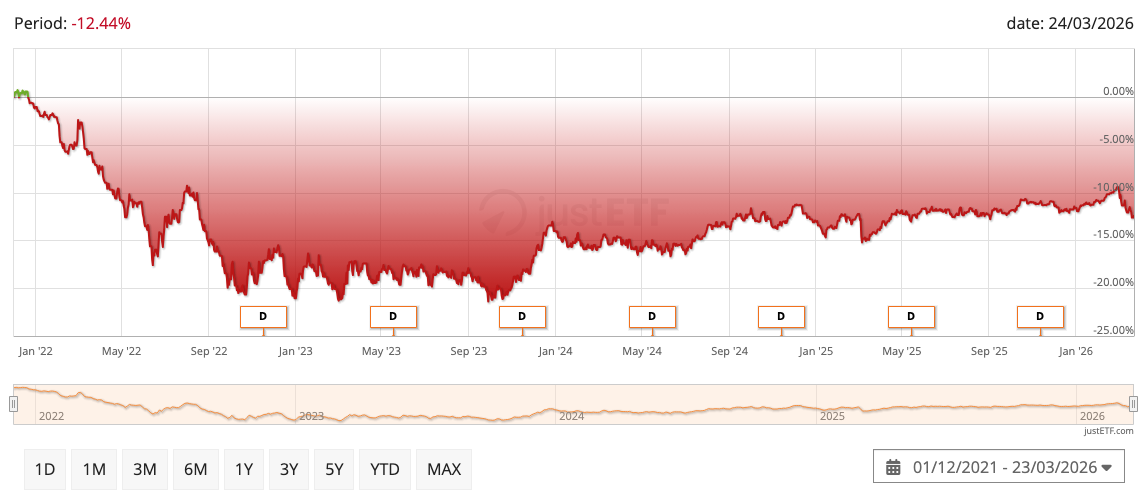
Source: justETF research, 24.03.2026. IBGM nominal total returns in EUR.
IBGM chosen to represent the intermediate Euro government bonds asset class. The deep red valley in the chart is the funk bonds fell into as inflation soared post-pandemic. Interest rates rose rapidly to contain inflation which caused bond ETF prices to tumble. (We’ll talk more about this chain reaction below.)
The performance of IBGM - the intermediate euro government bond ETF - is typical of the bond experience during this period. IBGM slid 20.7 % from December 2021 to 21 October 2022. It’s recovered a little since then, but not much.
While bonds turned down, money market ETFs headed up:
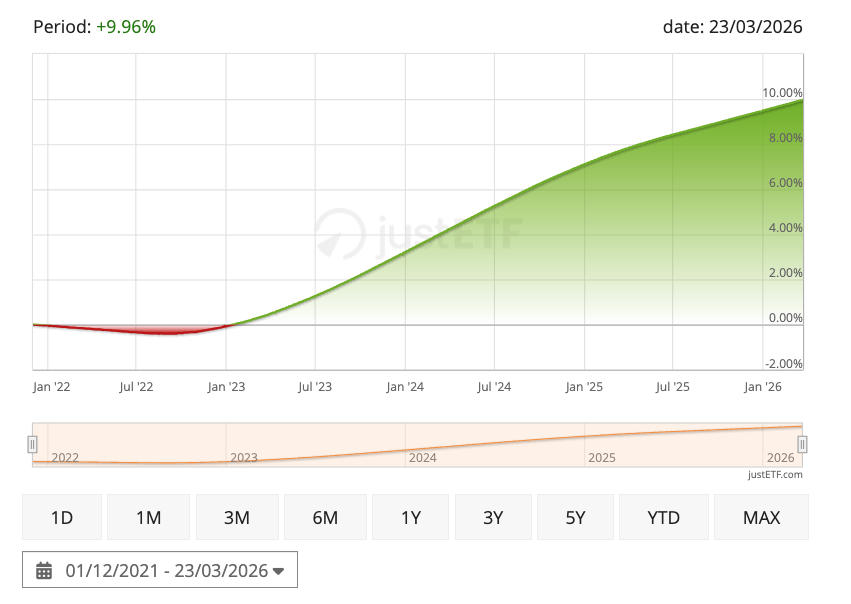
Performance of Money Market ETF (XEON)
On the same date that IBGM was down over 20 %, euro money market ETF XEON registered a 0.3 % loss. A comparative safe haven!
Since then, XEON has grown 10.33 % (up to 23 March 2026) while IBGM has scored 10.35 %. Essentially, the two asset classes are neck and neck since the bond ETF low point.
However, IBGM’s chart is drenched in red because it’s yet to recover from its earlier loss. Meanwhile XEON’s trendline looks like a sunlit upland by comparison. Yet there’s little to choose between the two ETFs for a new investor who entered the market after 21 October 2022. But what if you invested before that date?
Money market vs bonds: the long-term test
To properly compare the potential of money markets and bonds, we pitted XEON against IBGM over the longest timeframe possible:
Long-term Return Comparison: Bonds vs. Money Market
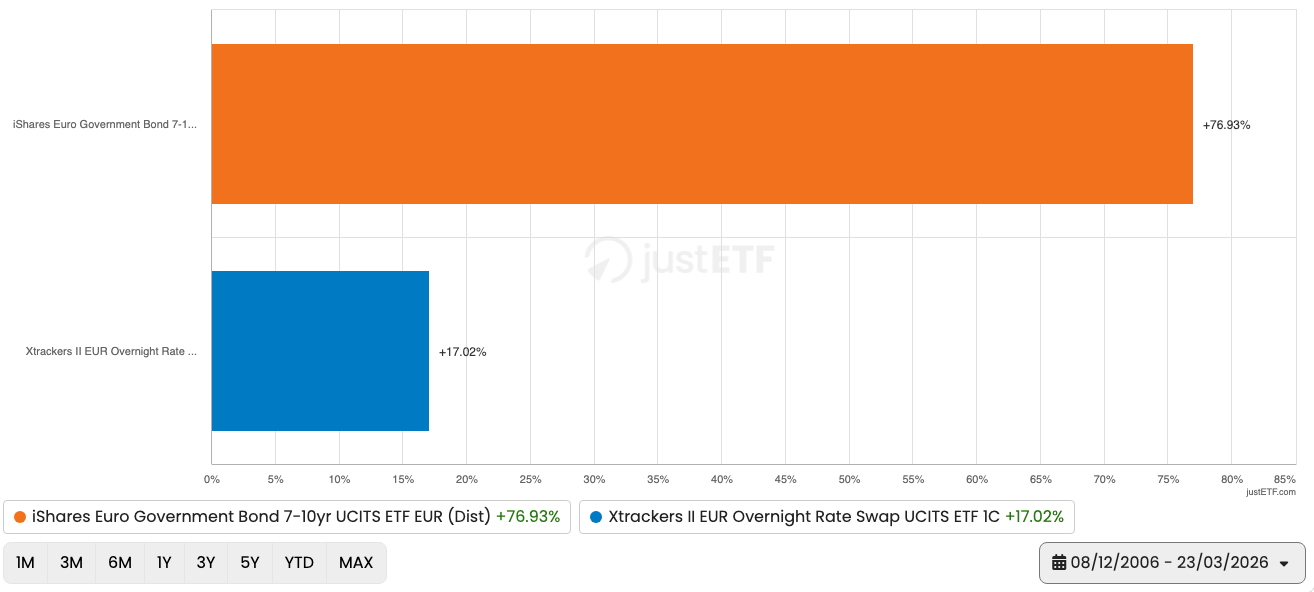
The chart tells us that Euro government bonds grew 4.5 times faster than money market funds over the past 19 years. That tells us a great deal about bonds and money markets’ long-term relationship. Over time bonds beat money markets. Over time bonds beat cash. (The money markets are a cash proxy).
The reason is that bonds are riskier than money markets and cash. The fact is that Bond ETFs can crash as we saw in 2022. By contrast, money market ETFs are low risk, low gain products. They’re places to park your money temporarily while you await better opportunities.
How to pit bond ETFs vs money market ETFs
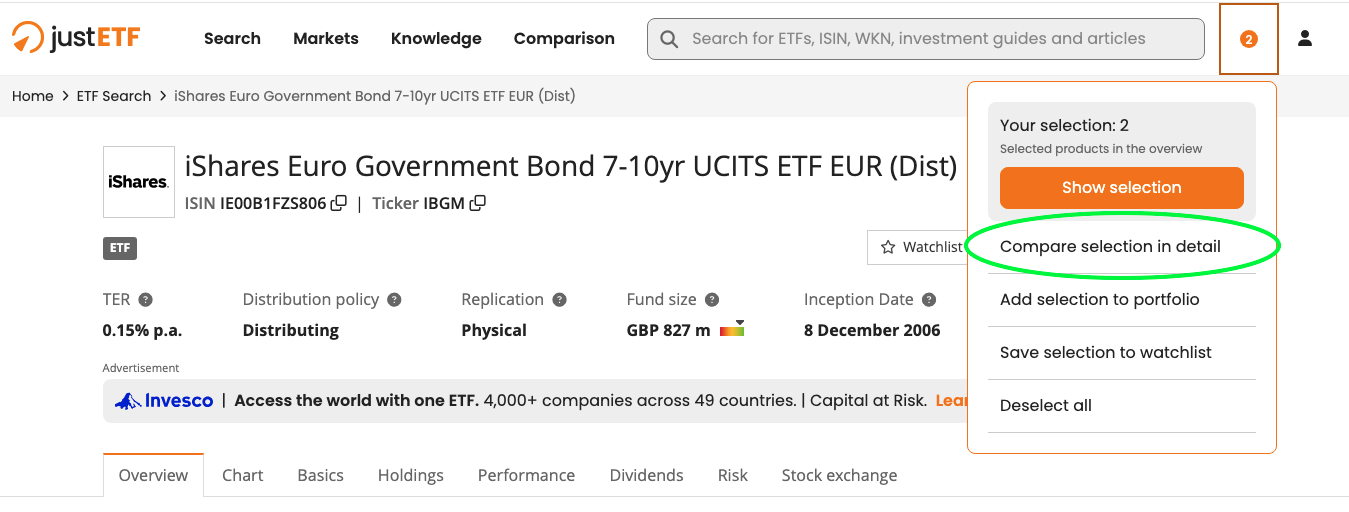
If you’d like to see for yourself, then it’s easy to do. Just type IBGM and XEON into the justETF search bar. Tap on the link, then hit the Compare button on the right of each ETF’s profile page.
Tutorial: ETF Comparison Tool
Now go to the little orange bubble in the top-right hand corner. Click: Compare section in detail. From there, hit MAX on the timeline bar or play with the dates on the calendar dropdown.
Over 12 years and more, government bond ETFs have proven more profitable than money market products. Money market ETFs win over shorter periods. You can choose other ETFs but we picked IBGM and XEON because they have long track records and because they are representative of their asset classes.
How reliable is this finding?
The historical record for government bonds and the money markets stretches back for over a century before the ETF era. However, the pattern remains the same. Money markets can dominate over short periods. But bonds are the long-term winners.
Money markets typically look good after inflationary shocks. That’s because the cash-like assets held by money market funds recover faster from interest rate hikes than longer maturity bonds. More familiar savings accounts are the perfect analogy for the money market / government bond ETF relationship.
When rates rise, easy-access accounts must pay more interest to compete in the market. Because you’re not locked in by a fixed term, you can quickly switch to a better product if you wish. Money market ETFs are like this. They invest in ultra short-term securities. Those assets mature at speed and can be quickly replaced by higher yielding replacements after an interest rate rise.
By contrast, bond ETFs resemble fixed term savings accounts. If you put money into a fixed term account and rates subsequently rise then you’re out of luck. You’re stuck on the same old interest rate that now looks annoyingly less competitive compared to newer products.
You can’t sell your savings account to someone else though. If you could, then a prospective buyer would naturally offer you less for it than before the interest rate rise. Because your lower-yielding account is less valuable than it was. This is why bonds took such a hit in 2022. You can sell your bond ETF whenever you like. But it’s full of securities that take time, often years, to mature.
Those assets were simply worth less than they were before 2022’s interest rate hikes. So bond prices naturally dropped as a result. Bond prices were hit so hard in 2022 because interest rates rose spectacularly from all-time lows. Interest rates had fallen to unprecedented levels as a result of first the Global Financial Crisis and then Covid.
As Covid subsided, economies opened back up. Demand was uncorked and overwhelmed supply chains. Inflation bubbled up. Under these conditions, interest rates spiked. That hurt bonds and the longer the average maturity of the bond ETF, the worse it did. Short maturity assets were king at the time. Hence money market ETFs came out on top.
It’s not always this way
The dynamic plays out in reverse when interest rates fall. In this scenario, bond ETFs with faraway maturity dates have the upper hand. Now they’re stuffed with securities that pay a higher rate of interest than the new market rate. Hence bond prices rise as buyers will pay more for higher yielding assets.
This is not a symmetrical bet. Normally bond investors are rewarded for taking risk just like equity investors. The upshot is that bonds beat money markets over the long run. But occasionally the risks materialise. That happened in 2022 with a vengeance. And that’s why money market ETFs look better versus bonds over any period shorter than about 12 years.
If you’re investing for the long-term then it’s useful to invest in both government bonds and money market ETFs on the defensive side of your portfolio. They are both good diversifiers when you hold a sizable equities allocation. However, there’s one more reason to hold government bonds in your portfolio…
Bonds beat money markets in demand-led recessions
When confidence falls and demand falters, central banks respond by cutting interest rates to stimulate the economy. That boosts bond ETF prices because they benefit from falling interest rates as explored above. You can see this effect at work during the worst recession of the past twenty years, the Global Financial Crisis:
Performance during the Global Financial Crisis
World equities (red line) fell 52.75 % at the height of the crisis on 9 March 2009. The money market ETF (blue line) did okay but its response was muted. Government bonds (orange line) did best of all, cushioning the portfolio against the losses caused by plunging equities.
The next chart clearly shows the performance differential between the ETFs when equities hit rock bottom:
ETF Performance at Market Bottom
IBGM’s return (blue bar) was three times the size of XEON’s (orange bar) at this point. Essentially it was government bonds that rode to the rescue this time around, not money markets.
Be prepared
If history and one glance at our news feeds tells us anything it’s that events are wildly unpredictable. It’s best to be ready for anything. Choose government bond ETFs to protect your portfolio when the economy is thrown into reverse. Think money market ETFs for your short-term liquidity needs.
Commodities are the asset class most likely to beat inflation. While Gold is the mercurial wild card asset that can work in almost any scenario but sometimes lets you down badly. Every one of these assets has a role to play in a diversified equity portfolio. Check out our guides to each one.


 On the same date that IBGM was down over 20 %, euro money market ETF XEON registered a 0.3 % loss. A comparative safe haven!
Since then, XEON has grown 10.33 % (up to 23 March 2026) while IBGM has scored 10.35 %. Essentially, the two asset classes are neck and neck since the bond ETF low point.
However, IBGM’s chart is drenched in red because it’s yet to recover from its earlier loss. Meanwhile XEON’s trendline looks like a sunlit upland by comparison. Yet there’s little to choose between the two ETFs for a new investor who entered the market after 21 October 2022. But what if you invested before that date?
On the same date that IBGM was down over 20 %, euro money market ETF XEON registered a 0.3 % loss. A comparative safe haven!
Since then, XEON has grown 10.33 % (up to 23 March 2026) while IBGM has scored 10.35 %. Essentially, the two asset classes are neck and neck since the bond ETF low point.
However, IBGM’s chart is drenched in red because it’s yet to recover from its earlier loss. Meanwhile XEON’s trendline looks like a sunlit upland by comparison. Yet there’s little to choose between the two ETFs for a new investor who entered the market after 21 October 2022. But what if you invested before that date?
 The chart tells us that Euro government bonds grew 4.5 times faster than money market funds over the past 19 years. That tells us a great deal about bonds and money markets’ long-term relationship. Over time bonds beat money markets. Over time bonds beat cash. (The money markets are a cash proxy).
The reason is that bonds are riskier than money markets and cash. The fact is that Bond ETFs can crash as we saw in 2022. By contrast, money market ETFs are low risk, low gain products. They’re places to park your money temporarily while you await better opportunities.
The chart tells us that Euro government bonds grew 4.5 times faster than money market funds over the past 19 years. That tells us a great deal about bonds and money markets’ long-term relationship. Over time bonds beat money markets. Over time bonds beat cash. (The money markets are a cash proxy).
The reason is that bonds are riskier than money markets and cash. The fact is that Bond ETFs can crash as we saw in 2022. By contrast, money market ETFs are low risk, low gain products. They’re places to park your money temporarily while you await better opportunities.
 Now go to the little orange bubble in the top-right hand corner. Click: Compare section in detail. From there, hit MAX on the timeline bar or play with the dates on the calendar dropdown.
Over 12 years and more, government bond ETFs have proven more profitable than money market products. Money market ETFs win over shorter periods. You can choose other ETFs but we picked IBGM and XEON because they have long track records and because they are representative of their asset classes.
Now go to the little orange bubble in the top-right hand corner. Click: Compare section in detail. From there, hit MAX on the timeline bar or play with the dates on the calendar dropdown.
Over 12 years and more, government bond ETFs have proven more profitable than money market products. Money market ETFs win over shorter periods. You can choose other ETFs but we picked IBGM and XEON because they have long track records and because they are representative of their asset classes.
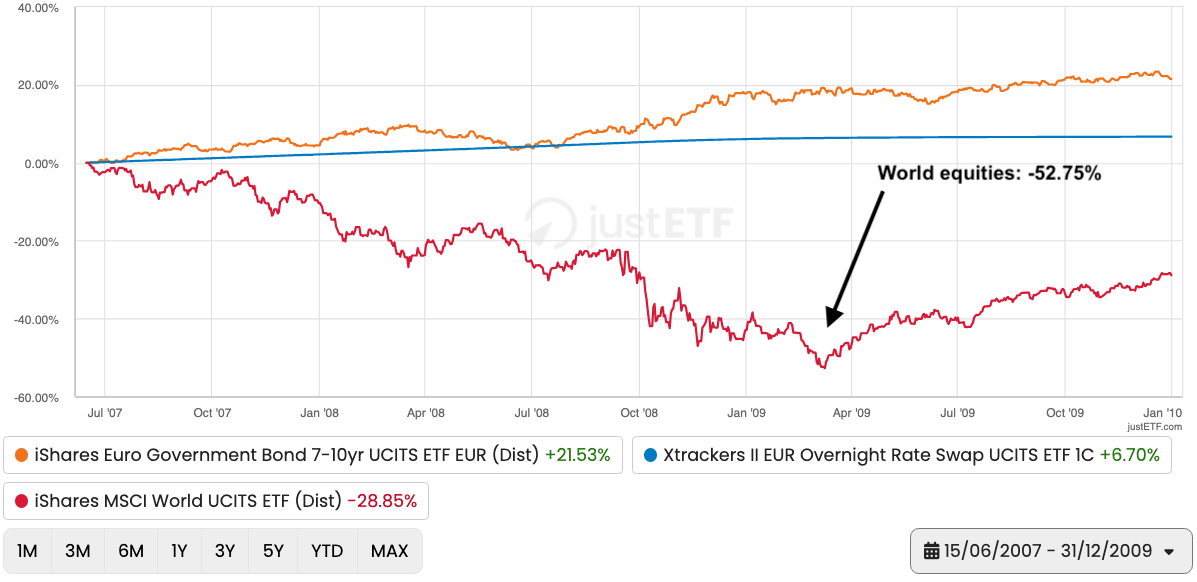 World equities (red line) fell 52.75 % at the height of the crisis on 9 March 2009. The money market ETF (blue line) did okay but its response was muted. Government bonds (orange line) did best of all, cushioning the portfolio against the losses caused by plunging equities.
The next chart clearly shows the performance differential between the ETFs when equities hit rock bottom:
World equities (red line) fell 52.75 % at the height of the crisis on 9 March 2009. The money market ETF (blue line) did okay but its response was muted. Government bonds (orange line) did best of all, cushioning the portfolio against the losses caused by plunging equities.
The next chart clearly shows the performance differential between the ETFs when equities hit rock bottom:
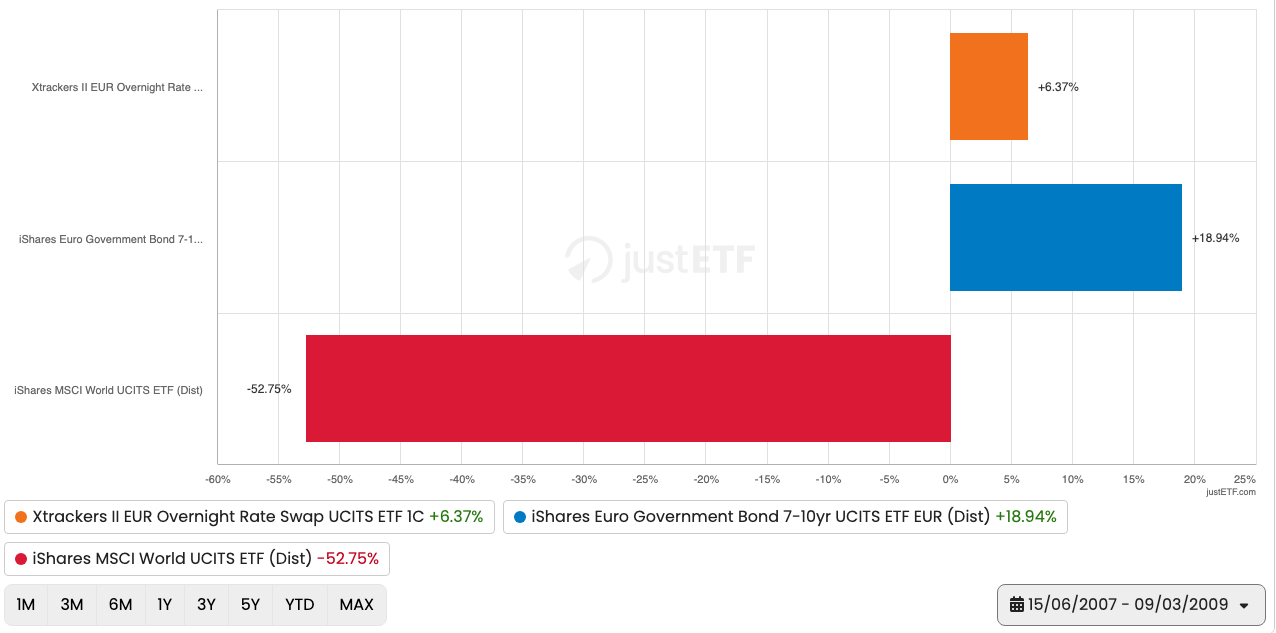 IBGM’s return (blue bar) was three times the size of XEON’s (orange bar) at this point. Essentially it was government bonds that rode to the rescue this time around, not money markets.


